

Key Takeaways
- Storm damage often begins with pre-existing issues such as deadwood, decay, damaged roots, cracks, or poor branch structure.
- Jacksonville’s mature tree canopy is valuable for shade, habitat, air quality, and stormwater management, so preservation should be considered when a tree can be safely retained.
- Professional pruning, tree health care, structural support, and removal each have a place in a responsible storm-preparation plan.
- Damaged trees near power lines, roofs, roads, or occupied areas should be treated as a safety concern, not a do-it-yourself project.
Jacksonville, FL homeowners live with towering live oaks, pines, water oaks, palms, and shade trees that add character to neighborhoods from San Marco and Riverside to Mandarin, Arlington, and the Beaches. Those trees can also become a serious concern when heavy rain, saturated soil, tropical winds, or an approaching hurricane exposes hidden decay, weak branch unions, root damage, or overextended limbs. Bushor’s Tree Surgeons helps property owners evaluate the condition before a small concern turns into storm-related property damage. Preventive tree care is not about making every tree storm-proof. No professional can promise that a tree will never fail in severe weather. The goal is to identify visible hazards, improve structure where practical, preserve healthy trees, and remove trees that present an unreasonable risk to people, homes, vehicles, driveways, or neighboring properties.
Why Jacksonville Trees Need Local Storm Preparation
Jacksonville’s geography creates varied growing conditions. A large oak in a historic Riverside yard may have a broad canopy over a home and sidewalk, while a pine near the coast may be exposed to sandy soil, salt air, and stronger winds. Trees in low-lying areas can also experience prolonged wet soil after heavy rain. These conditions make site-specific evaluation important. The City’s urban forestry program recognizes that a healthy tree canopy helps reduce stormwater runoff, moderate heat, filter air, and provide wildlife habitat. Local weather patterns add another layer of complexity. Jacksonville’s hurricane season, which runs from June through November, often brings tropical systems, heavy downpours, and gusty winds that test trees already weakened by summer heat and humidity. The St. Johns River, the region’s many creeks, and the Atlantic coastline also influence soil moisture and drainage, meaning a tree that appears stable during a dry spring may behave very differently after several days of saturating rain. Sandy soils, common in parts of Duval County, drain quickly in some areas but can offer limited anchorage when roots are damaged or when water levels rise beneath the surface. Neighborhoods with older housing stock often have trees that were planted decades ago, before modern utility lines, driveways, and home additions changed how much space those trees have to grow. Understanding these local patterns helps property owners decide when a routine inspection is enough and when a more detailed evaluation is warranted. A property assessment should consider more than a tree’s height. Arborists consider the species, trunk condition, canopy balance, roots, soil, nearby structures, past pruning, drainage patterns, and the areas where people regularly park, walk, or play. A healthy-looking tree may still have a branch union, cavity, root injury, or internal defect that deserves closer attention.
Warning Signs That Deserve a Professional Assessment
Homeowners do not need to diagnose a tree themselves, but they should take noticeable changes seriously. Calling for an evaluation is especially sensible when a mature tree is close to a house, garage, fence, pool enclosure, or driveway.
- A new or increasing lean: A sudden change in position can point to root, soil, or structural trouble.
- Cracks in a trunk or large limb: Deep splits and separating branch unions can indicate a failure point.
- Dead, broken, or hanging limbs: Deadwood can fall during ordinary weather and become more hazardous in high winds.
- Mushrooms, conks, cavities, or soft wood: These may be associated with decay and should be inspected in context.
- Root-zone disturbance: Trenching, construction, grade changes, compaction, erosion, and repeated vehicle traffic can harm roots.
- Sudden canopy thinning: Early leaf drop, dieback, or reduced vigor may indicate stress, pests, disease, or root problems.
- Heavy limbs over important targets: A structurally sound tree may still benefit from careful pruning for clearance and weight reduction.
How Bushor’s Tree Surgeons Helps Reduce Tree Risk
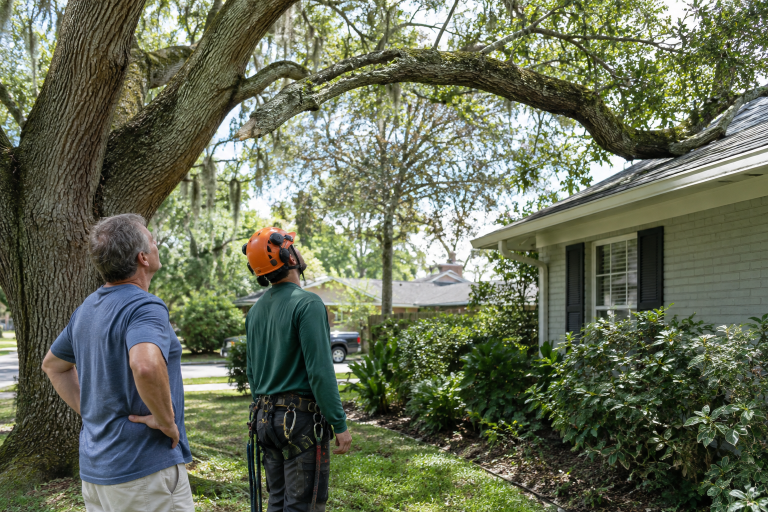
Bushor’s Tree Surgeons provides tree risk assessments for Jacksonville-area homes, businesses, property managers, and HOAs. The process begins with a review of the tree and its surroundings, including structures, utility areas, pedestrian spaces, fences, and equipment access. The arborist then evaluates the canopy, trunk, branch attachments, root flare, surrounding soil, and visible signs of decline or damage. Recommendations may range from monitoring and tree health care to targeted pruning, removal, or structural support. For valuable trees with weak or split unions, professionally designed tree cabling and bracing in Jacksonville may help limit movement in selected limbs or stems. Support systems are not a cure for severe decay or every structural issue, but they can be appropriate for certain viable trees when installed and maintained correctly.
Preventive Services That May Be Recommended
- Structural pruning: Removing dead, damaged, rubbing, poorly attached, or overextended branches while maintaining the tree’s natural form.
- Canopy clearance: Creating suitable clearance from roofs, driveways, sidewalks, and other areas where falling limbs could cause harm.
- Tree health care: Addressing stress factors through practical care recommendations, soil-focused services, and monitoring when appropriate.
- Cabling and bracing: Supporting selected weak unions or limbs in trees that are otherwise good candidates for preservation.
- Tree removal: Safely removing dead, severely declining, uprooted, or structurally unsound trees when preservation is no longer the responsible option.
- Stump grinding: Reducing a trip hazard and preparing an area for lawn restoration, landscaping, or replacement planting after removal.
When a Tree Problem Becomes an Emergency
After a major storm, stay clear of trees that are split, uprooted, leaning sharply, or caught in other branches. Never approach a limb or tree that is touching a power line, and contact the utility provider or emergency services when electrical hazards are present. Chainsaws and ladders are particularly dangerous around unstable, storm-damaged trees. Emergency tree service may be needed when a tree has fallen on a structure or vehicle, blocked a driveway, left a large limb suspended over an occupied area, or created an immediate threat to people or property. Bushor’s Tree Surgeons states that it provides 24/7 emergency response in Jacksonville and Northeast Florida for storm-damaged trees, fallen limbs, and urgent hazard removal.
Tree Removal Rules and Responsible Planning in Jacksonville
Before removing a large or potentially protected tree, property owners should verify the current requirements that apply to their specific site. Local rules can differ based on the tree’s location, size, species, condition, and whether it stands on private property, a public right-of-way, or another regulated area. Jacksonville’s tree procedures include requirements for protected trees and for work affecting public property, so checking before work begins can prevent costly mistakes. The best decision is not always removal. Healthy trees are a long-term asset to Jacksonville neighborhoods, but a tree with major structural defects, extensive decline, or a high-consequence location may need to come down. A professional evaluation helps owners make that decision based on condition and risk rather than appearance alone.
Prepare Before the Next Jacksonville Storm
Preparation works best when it starts well before a forecast. Many Jacksonville residents wait until a named storm is approaching. Still, by then crews may be booked across the region, and driveways and access routes may already be crowded with debris or vehicles. Scheduling an inspection during the spring or early summer gives time to complete recommended work, reduces emergency expenses, and allows trees to recover before peak wind season.
- Walk the property and note trees near roofs, parked vehicles, play spaces, and utility areas.
- Schedule an assessment for mature trees with cracks, deadwood, lean, decay signs, or declining canopies.
- Complete recommended pruning before storm conditions are forecast.
- Keep driveways and side yards accessible for emergency crews and equipment.
- Photograph trees and landscaping before hurricane season for property records.
- Save a qualified local tree service contact before an emergency occurs.
For Jacksonville property owners, thoughtful tree care protects more than a roofline. It helps preserve the shade, beauty, and environmental value that make local neighborhoods feel established and livable.
Location: Bushor’s Tree Surgeons | 5525 St Augustine Rd, Jacksonville, FL 32207 | (904) 789-8884
Conclusion
Preparing Jacksonville’s trees for storm season starts with identifying potential hazards early and choosing the right care for each tree. Regular inspections, professional pruning, tree health care, and structural support can help preserve healthy trees while reducing preventable risks. When a tree is severely damaged or presents an unacceptable safety concern, professional removal may be the most responsible option. Bushor’s Tree Surgeons provides Jacksonville property owners with tree assessments, preventive maintenance, cabling and bracing, removal, and emergency services to address a range of tree-care needs. By scheduling assessments before hurricane season, following local tree regulations, and responding promptly to warning signs, homeowners, HOAs, and property managers can better protect people, buildings, and surrounding landscapes. Although no tree can be guaranteed to withstand every storm, proactive care can support safer properties while preserving the shade, beauty, and environmental benefits of Jacksonville’s valuable urban tree canopy.