
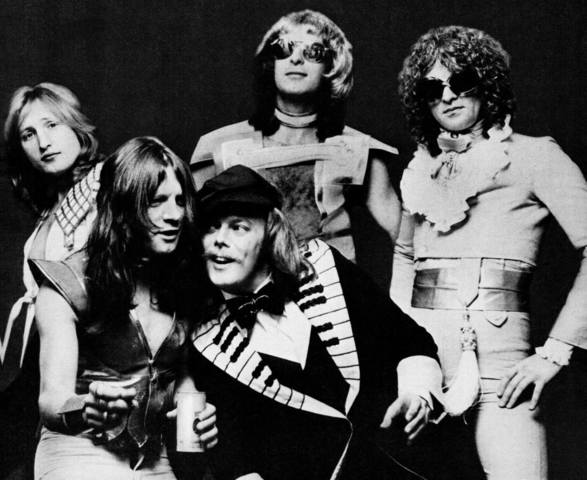
Mott the Hoople carved out a unique niche in rock history. They began as a gritty, blues-driven band and eventually transformed into glam rock icons. Their career was filled with near-misses, dramatic turnarounds, and one anthemic hit that defined an era: “All the Young Dudes.” Guided at a crucial moment by David Bowie, the band rose from obscurity to fame, influencing a generation of British rockers in the process.
While their commercial peak was short, Mott the Hoople’s journey from Herefordshire pubs to international stardom left a lasting mark on rock and roll.
| Band Name | Mott the Hoople |
|---|---|
| Origin | Herefordshire, England |
| Years Active | 1969–1974; Reunions in 2009 and 2013 |
| Genres | Glam Rock, Hard Rock, Proto-Punk |
| Classic Lineup | Ian Hunter, Mick Ralphs, Overend Watts, Verden Allen, Dale “Buffin” Griffin |
| Breakthrough Hit | “All the Young Dudes” (1972) |
| Associated Acts | Bad Company, British Lions, Ian Hunter solo, Mick Ronson |
| Labels | Island Records, Columbia, CBS |
Origins and Early Struggles
Mott the Hoople’s roots trace back to the Doc Thomas Group, formed in the mid-1960s by members of two Herefordshire bands: The Soulents and The Buddies. The original lineup included:
-
Stan Tippins (vocals)
-
Overend Watts (bass)
-
Verden Allen (organ)
-
Dale “Buffin” Griffin (drums)
Initially performing and recording in Italy, they returned to the UK and changed their name to Silence. While they worked hard, their demos failed to land a record deal—until producer Guy Stevens of Island Records stepped in.
Stevens liked the group’s energy but insisted on a new lead singer. He replaced Tippins with Ian Hunter, and rebranded the group as Mott the Hoople, named after a cult novel by Willard Manus.
1969–1971: The Cult Years
The band’s self-titled debut in 1969 blended hard rock with Bob Dylan-esque lyrics and won a cult following. It featured bold covers like:
-
“You Really Got Me” (The Kinks)
-
“Laugh at Me” (Sonny Bono)
-
“At the Crossroads” (Sir Douglas Quintet)
But their next albums—Mad Shadows (1970), Wildlife (1971), and Brain Capers (1971)—struggled to find commercial traction. While each LP had flashes of brilliance, none broke through to the mainstream. They hit rock bottom after a riot at London’s Royal Albert Hall and considered disbanding.
1972: Saved by Bowie
Just as Mott the Hoople prepared to call it quits, David Bowie—a fan of the band—stepped in. He offered them a new song, “Suffragette City,” but they passed. Instead, they recorded another Bowie composition: “All the Young Dudes.”
Released in July 1972 and produced by Bowie himself, the song became an instant glam rock anthem:
-
#3 UK Singles Chart
-
#37 Billboard Hot 100
-
A defining moment for the band
Their transformation into glam stars had begun.
1973: Riding the Wave with Mott
View this post on Instagram
Their 1973 follow-up album, simply titled Mott, solidified their success:
-
Peaked at #7 in the UK and #35 in the US
-
Featured hits:
-
“Honaloochie Boogie” (#12 UK)
-
“All the Way from Memphis” (#10 UK)
-
“Ballad of Mott the Hoople” (a fan favorite)
-
While Bowie faded from their immediate orbit, the band built a sound that merged glam flamboyance with working-class grit.
Lineup Changes and The Hoople
As their fame grew, the band began to fracture:
-
Verden Allen left before the Mott sessions
-
Mick Ralphs, frustrated with musical direction, left to form Bad Company
They were replaced by:
-
Ariel Bender (Luther Grosvenor of Spooky Tooth) on guitar
-
Morgan Fisher (Love Affair) on keyboards
The revamped group released The Hoople (1974), which became their most commercially successful LP:
-
Peaked at #11 UK, #28 US
-
Certified Gold in the UK
-
Singles:
-
“Roll Away the Stone” (#8 UK)
-
“The Golden Age of Rock ‘n’ Roll” (#16 UK)
-
Decline and Rebranding: Mott and British Lions
Later in 1974, guitarist Mick Ronson (formerly of Bowie’s Spiders from Mars) joined, but he and Ian Hunter both exited shortly after to pursue solo work. The remaining members rebranded as:
-
Mott with singer Nigel Benjamin
-
Released Drive On (1975) and Shouting and Pointing (1976)
When Benjamin left, John Fiddler (of Medicine Head) stepped in. They changed their name again to British Lions and released two albums, neither of which charted significantly. The group disbanded quietly in the early 1980s.
Ian Hunter and Mick Ronson
Post-Mott, Ian Hunter enjoyed a solo career with moderate success. His best-known solo track is:
-
“Once Bitten, Twice Shy” (1975), later covered by Great White
He continued to collaborate with Mick Ronson until Ronson’s death from liver cancer in 1993. Together, they released several albums and toured widely, further cementing their status among rock connoisseurs.
Reunions and Revival
In 2009, all five classic Mott the Hoople members reunited for five sold-out shows at London’s Hammersmith Apollo. The reunion was praised by critics and fans alike for its energy and nostalgic power.
A second reunion followed in 2013, with Martin Chambers of the Pretenders joining on drums. They played shows in London, Manchester, Birmingham, Glasgow, and Newcastle. These performances reaffirmed Mott the Hoople’s influence on the glam and punk scenes.
Mott the Hoople’s Legacy
Though often underrated in mainstream retrospectives, Mott the Hoople played a crucial role in bridging the gap between late-60s hard rock and 70s glam and punk. Their impact can be heard in bands like:
-
Queen (who supported them on tour)
-
Def Leppard
-
The Clash
-
Oasis
“All the Young Dudes” remains a rock classic—covered by artists like Bruce Dickinson, The Killers, and World Party—and a symbol of youth, rebellion, and hope.
Discography Highlights
| Album | Year | Notes |
|---|---|---|
| Mott the Hoople | 1969 | Cult debut with Dylan-inspired rock and bold covers |
| Mad Shadows | 1970 | A darker, rawer follow-up |
| Brain Capers | 1971 | Aggressive proto-punk energy |
| All the Young Dudes | 1972 | Produced by David Bowie, breakthrough album |
| Mott | 1973 | Polished glam rock with two UK hit singles |
| The Hoople | 1974 | Most commercially successful album |
| Drive On (as Mott) | 1975 | First without Hunter or Ronson |
| British Lions (as British Lions) | 1977 | Final iteration of the group |
Final Thoughts
Mott the Hoople never followed the trends—they created them. From near obscurity to glam rock glory, their music blended honesty, attitude, and flair. Thanks to Ian Hunter’s lyrics, Bowie’s blessing, and a hard-working lineup, the band earned their place in rock history.
Though their ride was bumpy, Mott the Hoople proved that sometimes it takes just one anthem to change everything.